
着たままお風呂、手でこする、やすりがけ、土染め、糊付け、シーウォッシュ…私はシーウォッシュ以外、一通りやったことがあります笑 本来自然に落ちていくデニムの色を、あえて作る行動学。この行為は邪道か冒涜か──
色落ちはデニムの楽しみ方のひとつ。自然に落ちるのも、あえて作るのも、それぞれの良さがありますよね。今回はその色落ちに惹かれる心理と行動を分析しながら、どんなアプローチでも一緒に楽しめるキーワードを探ってみたいと思います。
1|日本のデニム文化・黎明期
戦後アメリカ軍の放出品として流通が始まった日本のデニム市場。その中に新品がどれくらいあったかはさておき、そのほとんどは色落ちした古着だったのではないかと思われます。
時間の経過によって刻まれた、オーナーの記憶「色落ち」──ヒゲや蜂の巣といった数々の愛称からも、色落ちしたデニムを楽しそうに語る愛好家の笑顔が目に浮かびます。その感性は日本人が見出した「美」の一つとする見方もあるほど。
当時デニムから感じとった自由というスピリッツ。すでに導入期から、ファッションや生き方の表現として、色落ちしたデニムが生活へ浸透していった──そんな歴史を持つ日本のデニム文化なら、ストーンウォッシュが生まれたのも必然ということかもしれませんね。
2|なぜ人は「良い色落ち」を求めるのか
デニムの「良い色落ち」を求める行動を整理してみると、4つの組みあわせと2つの方向性が見えてきます。
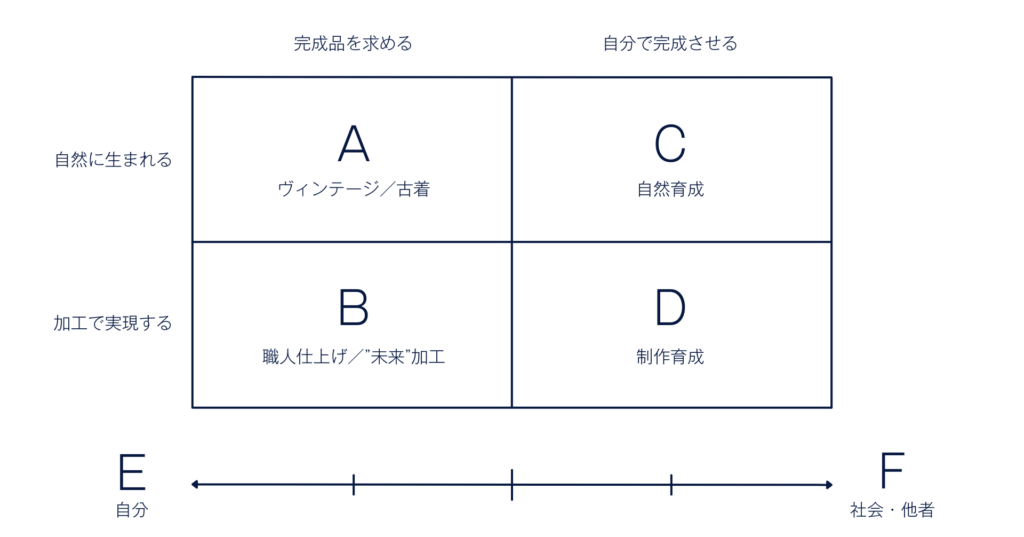
①誰が完成させるのか?(主体)
・A:完成品を求める
・B:自分で完成させる
②どう作られるか?(プロセス)
・C:自然に生まれる
・D:制作で作り上げる
この2つをかけ合わせると、現代のデニム市場では
①A×C…ヴィンテージ/古着
②A×D…こだわりのリプロダクト、職人技のユーズド加工
③B×C…気負わず着用して楽しむ、自然体のお付き合い
④B×D…テクニックで手に入れるマイ理想デニム
この4つの組みあわせに分類できそうです。そしてこの4つの根底には、
③誰に対して表現したいのか?(承認の方向)
・E:自分自身…自分の行動の成果に対する満足感
・F:他人・社会…周りの評価から得られる満足感
という承認の方向性があると感じました。つまり人は、自己と社会の立ち位置にゆらぎながら、色落ちするデニムの風合いに魅了され、時間とお金を消費しているという構造が見えてきます。
3|なぜ色落ちが魅力的なのか
次にこの構造を手がかりに、消費者の心理を分類してみます。するとデニム製品は、人の基本的欲求にしっかり応えているプロダクトだということが見えてきます。
- 自己物語:自分の時間を可視化したい
- コントロール感:結果に届く手ごたえ、自己効力感
- 即時フィードバック:成果が見える化で続けやすい
- 所属と承認:共通言語で仲間と語れる
- 儀式の安心:型や手順があると落ち着く
- 不確実性の回避:失敗やリスクを減らす工夫ができる
- 美的流暢性:馴染む美しさ=見慣れたパターンは心地いい
- IKEA効果:手間ひまかけた分愛着が増す、関与が価値を高める
つまりデニムは、過ごした時間の可視化である「色落ち」により、自分の存在を価値あるものに変換し、時間の流れを味わわせてくれる装置になっているいうことです。ヴィンテージや古着の色落ちに胸が高鳴るのも同じ原理。前オーナーの過ごした時間が刻まれた「色落ち」もまた、自分の価値を高め、あこがれや共感を生んでくれる装置なのです。
最高の承認と代え難い愛着。いっしょに寄り添い、在りたい自分を実現してくれる相棒の様に、無償で自分を肯定し認めてくれる存在。結果である「色落ち」が魅力的なのではなく、結果に至るプロセスにこそ本質があるということ。ここに色落ちの快と、良い色落ちを求める基盤があるのだと思います。今日もまた着用してしまうのは、無意識にその感動を求めているからなのかもしれません。
ここまでで、色落ちには構造と方向性、そして基本的欲求の心理が働いていることが分かりました。それではこの「色落ちの行動学」から、デニム文化をもっとより良い機会に拡げていく、共通のキーワードを考えてみましょう!
(コラム)以前岐阜のアパレルメーカー XX development の皆さんが、ユーズド加工を ”未来加工”と表現されていてハッとしたことがあります。過去の模倣ではなく、未来の着用体験の入り口を設計するという発想──まさにこの色落ちの行動学を踏まえた、作り手だからこそ届けることができる、最高にクリエイティブな視点に立った提供方法ですよね。
4|時間を楽しむデニム文化づくりへ
みんなが味わっていたのは、たどってきた選択が形に現れていく実感。様々な社会的背景をもつ人々の、多種多様で魅力的な人生──ボーダーラインを取っ払い、その時間を一気に引き出し距離を縮めてくれるキーワードとは──求めているのは、色落ちという結果にフォーカスしない、誰もが扱えるシンプルな視点であること。私が考えた視点を4つ、皆さんに提案したいと思います。
①出会い:手に入れた時のこと、その時の気持ち
②時間:どれくらい着たのか、その時期どんな気持ちだったか
③プロセス:着ていた時の楽しかったこと/色落ちのためにチャレンジしたこと
④気づき:気に入っている所/もっとこうしたいと思う所
ありきたりの視点かもしれませんね。でもこれはまさに人を知るためのパワーワード。引き出すことでその人のルーツや人となりが見え、共感を生んでくれる──そしてあなた自身が表現された美しい色落ちのプロセスを、自らも開示することで、色落ちしたデニムはさらに深く美しい、社会からの承認を双方に与えてくれるはずです。
入り口の違うデニムフリークもファッショニスタも、過ごした時間と共有する時間を同時に味わうことのできる素材、それがデニム。この素材の可能性を拡げ、デニム文化をもっと前に、もっとみんなで味わえる機会を増やしていく──fade ink.が目指すのは、まさにそんな世界です。今あなたが着ているそのデニム、いつ出会い、今誰と、どんな充実した時間を過ごしていますか?ぜひ聞かせてくださいね!コメントお待ちしています!
<English Ver.>
The Behavioral Side of Denim Fades — How to Share the Joy through simple types & psychology
Bathing with them on. Hand-rubbing. Sandpapering. Mud-dyeing. Starching. Sea-washing… I’ve tried pretty much everything except the sea-wash (guilty!). Fades are meant to happen naturally, and yet we sometimes make them on purpose. Is that sacrilege—or just another way to play?
Either way, fading is one of the joys of denim. Letting it happen or giving it a nudge—both have their charms. Below, I look at the psychology and behaviors that draw us to “good fades,” and offer a few shared keywords so any approach can be enjoyed together.
1|Japan’s early days with denim
In postwar Japan, denim first spread as U.S. military surplus. Whether many pieces were unworn is unclear, but it’s likely most were already faded.
Those fades—time etched into cloth—carried an owner’s memories. The nicknames we still use, like whiskers and honeycombs, hint at a culture where fans happily compared and talked about wear patterns. Some even say that way of appreciating “fade beauty” is a distinctly Japanese discovery.
Freedom was part of the denim spirit people felt then. Because faded denim took hold from the very beginning—as fashion and as a way of living—Japan was natural ground for innovations like stone wash. In that sense, its rise here feels almost inevitable.
2|Why do people chase “good fades”?
If we map the behaviors around chasing fades, two simple axes—and one “satisfaction” direction—appear.
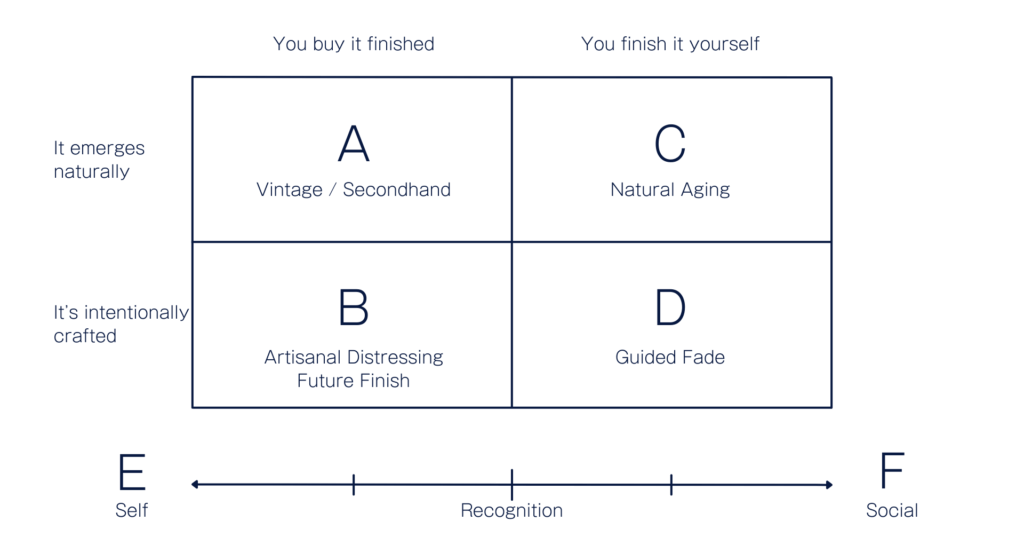
(1) Who completes it?
A: You buy it finished
B: You finish it yourself
(2) How is it made?
C: It emerges naturally
D: It’s crafted on purpose
Combine those and today’s market clusters into four familiar patterns:
- A×C — Vintage / secondhand
- A×D — High-fidelity repro, artisan distressing (a.k.a. a “future finish”)
- B×C — Wear it with no fuss and let it age; an easy, natural relationship
- B×D — Use techniques to build your ideal pair
Beneath all four sits a third element:
(3) Who is it for—where does satisfaction point?
E: Inward — your own sense of fulfillment
F: Outward — recognition from others / society
We all shift back and forth between E and F. That gentle sway—between self and social—helps explain why we’re so captivated by the look of worn denim, and why we keep investing time (and money) into it.
3|What makes fades so appealing?
Seen through that simple map, denim answers a bunch of very human needs:
- Self-story — letting your time show up as visible “traces”
- Control — a reachable result; the I can do this feeling
- Instant feedback — progress you can see, which keeps you going
- Belonging & recognition — a common language to talk with peers
- Ritual comfort — steps and “forms” that calm the mind
- Risk reduction — ways to avoid mistakes and regret
- Aesthetic fluency — that pleasing familiarity (patterns the eye knows feel right)
- The IKEA effect — the more you put in, the more you love it (personal effort raises perceived value)
In other words, denim turns the visible passing of time—fades—into a device that affirms who we are. The thrill we feel looking at vintage is the same logic: someone else’s time, etched into fabric, can lift our own sense of value and spark admiration or empathy.
So the heart of the appeal isn’t the result alone; it’s the path to it. That’s the bedrock beneath the hunger for “good fades,” and maybe why we keep reaching for the same pair again today—chasing that feeling without even thinking about it.
Having a structure (the four combinations) and a direction (inward/outward satisfaction) is helpful—but not to rank methods. It’s a map of needs and motivations. The real question is: how do we use this map to design better shared moments around denim?
(Column) A while back, the Shiga-based brand XX development described distressing not as “used finish” but as a “future finish.” That framing—not copying the past, but crafting an entrance into tomorrow’s wearing experience—clicked for me. It’s exactly the kind of creative, maker-side perspective this “behavior of fades” points to.
4|Toward a denim culture that savors time
What we’re really after is this: the felt sense that the choices we’ve made over time start to take shape. People come from all sorts of backgrounds and live all kinds of lives. If we want to pull those stories closer—without getting stuck on “the result”—we need simple prompts anyone can use. Here are four I’d love to propose:
- The Encounter — When did you get it? What did it feel like then?
- The Time — How long have you worn it? What season of life was it?
- The Process — What did you do (or not do)? What was fun? What was hard?
- The Findings — What do you love? What would you change or try next?
They may look everyday, but they’re powerful. Ask these and someone’s roots and character come into view—and empathy follows. And when you open up your process the same way, your fades gain depth, and recognition moves both ways.
Denim gives both the long-time freak and the new fashion lover a way to taste time worn and time shared—at once. Let’s widen that possibility and create more chances to enjoy it together. That’s the world fade ink. wants to help build.
So, the jeans you’re wearing now—when did you meet, and who are you spending this season with? Tell me your story — I’m listening.